|
✦ DJS AVIATION LLC ✦ ISSUE 004 ✦ JULY 2026 ✦ KCPT ✦
|
The Squawk Sheet
Real-world maintenance intelligence from DJS Aviation
| ● |
● |
● |
VOL. I • EST. 2026
|
● |
● |
● |
|
|
|
|
✦ Preflight Brief
Squawks don’t age like wine. They age like milk.
Welcome back to The Squawk Sheet. July in Texas means one thing in the hangar: everything that was marginal in May is now failing. The heat doesn’t create problems — it just speeds up the ones that were already there. This month we have three items that deserve your attention before your next flight.
First, a fresh FAA advisory that affects every piston aircraft in the fleet, regardless of make, model, or age — and it has nothing to do with the engine. Second, what your spark plugs are quietly recording about your engine right now — and how to read what they are telling you before the engine has to say it louder. Third, an honest look at the piston pre-buy market in mid-2026 and what it means if you are buying, selling, or simply deciding whether to stay.
We also want to introduce you to someone. The person whose standards are behind every aircraft that leaves our facility. More on that below. As always — a joke at the end. Some traditions earn their keep.
|
|
01
|
FAA Watch — Airworthiness Advisory
SAIB 2026-10R1: Your Seat Belts
May Not Hold in a Crash
|
|
|
On April 8, 2026, the FAA issued Special Airworthiness Information Bulletin SAIB 2026-10, subsequently revised as 2026-10R1 on April 15. It applies to every general aviation aircraft flying today — regardless of make, model, year, or engine. The subject is the last piece of safety equipment most pilots ever think about: their torso restraint system and seat belts.
The NTSB triggered the bulletin after reviewing a series of accidents in which restraint systems failed under crash loads — not because the accidents were unsurvivable, but because the harnesses gave way before they were required to. The most documented failure point: the Y-junction stitching, where the two shoulder straps converge and connect to the single fuselage attach strap behind the pilot’s head. A methodical search of NTSB accident dockets identified at least fifteen general aviation accidents in which restraint assemblies partially or completely failed at this exact location. In at least one case, that failure converted a survivable impact into a fatal one. This bulletin is advisory, not an AD — the FAA has not yet elevated this to a mandatory action. But the FAA does not issue fleet-wide advisories as a precaution. They issue them because the data said something worth saying.
|
▶ Advisory Data Plate
|
|
Bulletin Number
SAIB 2026-10R1
|
Issued
April 15, 2026
|
|
Aircraft Affected
All general aviation aircraft — every make, model, and year with any installed torso restraint or seat belt system
|
Primary Failure Point
Y-junction stitching — where dual shoulder straps converge to single fuselage attach strap
|
|
Recommended Action
Inspect at next annual — verify TSO-C114 or TSO-C22g compliance
(advisory, not mandatory)
|
|
Issued by: FAA Aircraft Certification Service ·
Contact: Compliance & Airworthiness Division — 817-222-5390
|
What This Means For You
The technical concern is not complicated. A significant portion of the GA fleet is still flying with restraint systems manufactured to older, obsolete Technical Standard Orders — some predating 1987. Current TSO minimum standards (TSO-C114 for torso restraints, TSO-C22g for seat belts) require systems capable of withstanding crash loads on the order of 3,000 pounds or more, depending on configuration. Systems built before those standards were established may not reach that threshold. And the problem is not always visible: webbing and stitching that looks intact on a casual walk-around can be structurally compromised by years of UV exposure, heat cycling, or simple age-related degradation of the synthetic fibers.
The inspection is straightforward. Start with the label on your shoulder harness hardware. TSO-C114 or TSO-C22g on the label means the system was built to current minimum standards. No label — or a label referencing an older specification — means a closer look is warranted. Run your hands along the full length of both shoulder straps: you are feeling for fraying, unusual stiffness, brittle webbing, or discoloration that suggests degradation. Spend extra time at the Y-junction, the single point where both shoulder straps converge. If you have an inertia reel, pull sharply: it should lock immediately and release cleanly. Inspect every anchor point, buckle, and hardware fitting for deformation or corrosion.
We have been doing annuals for a long time. We have replaced more restraint hardware than owners expected — hardware that looked fine, felt adequate, and was neither. A replacement shoulder harness and lap belt set from a respected manufacturer runs a few hundred dollars. There is no way to price what happens when a survivable crash becomes an unsurvivable one because the harness gave way. Effective immediately, we are adding restraint system verification to our standard annual inspection process. If your annual is coming up, it will be included. If it is not — call us anyway.
| |
The seat belt is the last line of defense between a survivable accident and an unsurvivable one. Most pilots have never examined theirs with the same care they give the oil filter. That is the wrong priority. Let’s fix it.
|
|
|
“A spark plug is a window into your engine.
Most owners never look through it.”
— The Tech Desk
|
|
02
|
The Tech Desk
What Your Spark Plugs Are Trying
to Tell You Right Now
|
|
|
Every piston engine carries a set of small, threaded witnesses screwed directly into each combustion chamber. They fire thousands of times per flight hour under conditions of intense heat and pressure, and in doing so they record — in carbon deposits, electrode wear, and color patterns — a precise account of how that engine has been operated. Most owners hand them to a mechanic at annual who cleans, gaps, and reinstalls them without a word. That is maintenance. Reading them first is intelligence.
July is the right month for this conversation. Summer heat, high CHTs, and the rich ground-run mixtures that accumulate during long Texas taxi sequences all leave fingerprints on plug electrodes and insulators. If you know what you are looking at, a used spark plug tells you more about combustion health than any single gauge in the cockpit. Here is what to look for — and what each reading means.
|
▶ Reading Your Plugs: What Each Pattern Means
|
|
✓
|
Light tan or gray deposits — the correct answer
A plug with a light tan or gray insulator nose and minimal electrode wear is running at the right temperature in the right mixture. This is what a healthy, properly operated engine produces. If all your plugs look like this, the engine is content. Keep doing what you are doing.
|
|
|
✓
|
Dry, sooty black carbon — the rich mixture signature
Black, fluffy, dry carbon fouling is the unmistakable result of a mixture that has been running too rich for too long. In July, the most common cause is prolonged ground operations at full rich — the exact scenario playing out at airports with long taxi sequences in 100°F heat. A plug fouled this way will misfire under load. The fix is leaning correctly during taxi and ground runup. The plug is the proof you have been skipping that step.
|
|
|
✓
|
Wet, oily deposits — oil is getting into the combustion chamber
A wet, shiny plug with oil contamination on the insulator is a different conversation entirely. Oil past worn or stuck piston rings, a failing valve guide seal, or a breather system issue can all put oil into a combustion chamber. This reading does not fix itself. It is the engine telling you something specific — and the answer is not a new plug. It is a diagnosis of where the oil is coming from.
|
|
|
✓
|
Eroded or rounded electrodes — the plug is past its useful life
Electrodes erode with every firing. A sharp, square center electrode fires reliably and consistently. A rounded, pitted, or eroded one requires higher voltage to bridge the gap, stresses the magneto, and increases the probability of misfire under high-power or high-altitude conditions. Aviation spark plugs are typically serviced at 100-hour intervals and replaced at 500 hours or per manufacturer limits. If yours are approaching those numbers and the electrodes look worn, replace them. Do not gap-and-go your way through another season.
|
|
|
✓
|
Rotate plugs on the correct firing-order sequence — not just top-to-bottom in the same hole
Most shops clean plugs and reinstall them in the same hole. Better shops swap top to bottom. The correct procedure does both of those things and one more: it rotates plugs to the next cylinder in the firing order, which reverses the electrical polarity at the electrode. That distinction matters more than most owners realize — and more than most shops will tell you. See the technical note below.
|
|
|
▶ Tech Deep Dive — Why Polarity Makes Plug Rotation a Science, Not a Habit
|
|
The magneto generates spark through a rotating permanent magnet. As that magnet spins, its north and south poles induce alternating positive and negative electromotive force in the coil. The result: the magneto sends a positive voltage pulse down one lead, a negative pulse down the next, positive down the one after that — alternating all the way around the distributor. Every lead position always fires at the same polarity. That polarity never changes as long as the plug stays in the same position.
Here is why that matters at the electrode level. When the arc jumps the gap, electrons travel in one direction and ions — metal atoms that have shed an electron — travel in the opposite direction. The electrode from which ions are departing is losing mass, atom by atom, with every firing. That electrode erodes. The other one does not, or erodes far more slowly. Pull any set of plugs that have been sitting in the same hole for 100 hours and look at them: one electrode will show measurably more wear than the other. That is polarity at work.
A correct rotation moves each plug to a position that fires at the opposite polarity. Now the electrode that was losing metal starts gaining it back — or at minimum, the wear shifts to the opposite electrode and the total gap growth is equalized across both. There is a third factor as well: ignition lead length determines how much capacitance the lead adds to the circuit, and capacitance directly affects how much current crosses the gap at each firing. Longer leads carry more capacitance. More capacitance means more current, which means faster electrode erosion. A proper rotation also swaps short leads for long leads, equalizing this wear source simultaneously.
|
Manufacturer-Specified Rotation Sequences — Horizontally Opposed Engines
|
|
4-Cylinder Engine
1T → 4B 2B → 3T
1B → 4T 2T → 3B
Ref: TCM SIL 03-2B Chart 1;
Lycoming SI 1042X
|
6-Cylinder Engine
1T → 6B 2B → 5T 3T → 4B
1B → 6T 2T → 5B 3B → 4T
Ref: TCM SIL 03-2B Chart 1;
Lycoming SI 1042X
|
T = top plug · B = bottom plug · Number = cylinder position.
Each move simultaneously reverses firing polarity, swaps lead length, and cycles the plug between top and bottom positions.
|
|
⚠ Important: Electronic Ignition Changes Everything
Polarity reversal is a characteristic of magnetos, not electronic ignition systems. If your aircraft has an Electroair, Surefly, or similar EI unit on one set of plugs, the rotation strategy changes — and EI plugs cannot be rotated with magneto plugs because the gap specifications differ. If you have mixed ignition, ask your shop specifically how they are handling plug rotation. If they do not have an answer, that is itself an answer.
|
Continental SIL 03-2B mandates plug rotation at every 100-hour inspection and specifies the exact sequence. Lycoming SI 1042X does the same. These are not suggestions. They are published manufacturer requirements. When we pull your plugs, we follow the sequence — every time, on every engine.
|
| |
Spark plugs are consumable parts with a memory. Every flight leaves a record on them. The mechanics who read that record — and rotate correctly when they reinstall — are the ones who catch problems before the problems introduce themselves in flight.
|
|
|
03
|
The Watchman’s View
The Pre-Buy Market in Mid-2026:
What the Numbers Actually Mean
|
|
|
The piston aircraft market in mid-2026 is not behaving the way most owners expect, and if you are weighing a purchase, a sale, or simply deciding whether the aircraft you own still makes sense to keep, the numbers are worth understanding before you act on instinct.
Three simultaneous forces are shaping the market — and they pull in different directions. Here is an honest read on each one:
|
|
Aircraft Values
Still High
Well-maintained Cessna 172s, PA-28s, and Bonanzas remain near post-pandemic highs. Buyers who entered the market in 2021-2022 are sitting on paper gains — but selling means re-entering as a buyer.
● Seller’s Market
|
Engine & Parts Costs
2×+
Engine overhaul costs have more than doubled since 2017. A piston engine that cost $25K then runs $55–$65K today. Parts back-orders are measured in months. Pre-buy inspections now routinely surface engine time-since-overhaul as the dominant value variable.
● Still Rising
|
Pre-Buy Inventory
Tighter
Quality inventory at reasonable prices is genuinely harder to find in mid-2026 than it was three years ago. Buyers competing for the same well-documented aircraft are often bidding against each other. The days of patient, low-offer acquisition are largely over for popular models.
● Buyer Challenge
|
|
⚠ The bottom line:
The aircraft you own today is almost certainly worth more than you paid for it. The aircraft you might buy to replace it is also worth more than it used to be. Upgrading is expensive in both directions right now.
|
|
|
What does this mean practically? If you are considering a sale, the window is favorable on paper — but only if you have somewhere logical to go. Selling high and buying high often nets neutral or worse, once you factor in the transaction friction. If you are considering a purchase, the pre-buy inspection has never mattered more. An aircraft listed at $140,000 with a $60,000 engine approaching TBO and a trail of deferred maintenance items has an effective entry cost that does not appear in the asking price. That calculation belongs in the conversation before the purchase agreement, not after.
For owners who are staying: this market makes a quiet argument for treating what you have with discipline. A well-maintained aircraft with complete, clean logbooks and no deferred items commands a measurable premium over an identical aircraft with a complicated records history. The maintenance investment you make today is the sale premium you capture later. We see the difference on pre-buys regularly: it is not always the engine hours that separate a $110,000 aircraft from a $130,000 one. More often than not, it is the logbooks.
| |
Thinking about buying, selling, or considering a pre-buy? We do them, and we do them honestly — which means we will tell you when it is not worth the trip. Reply with the make, model, and location of the aircraft and we will give you a straight read.
operations@maildjs.com
|
|
|
04
|
Meet the Crew
Doug Kahanek — A&P / IA
The Standard Bearer
|
|
|
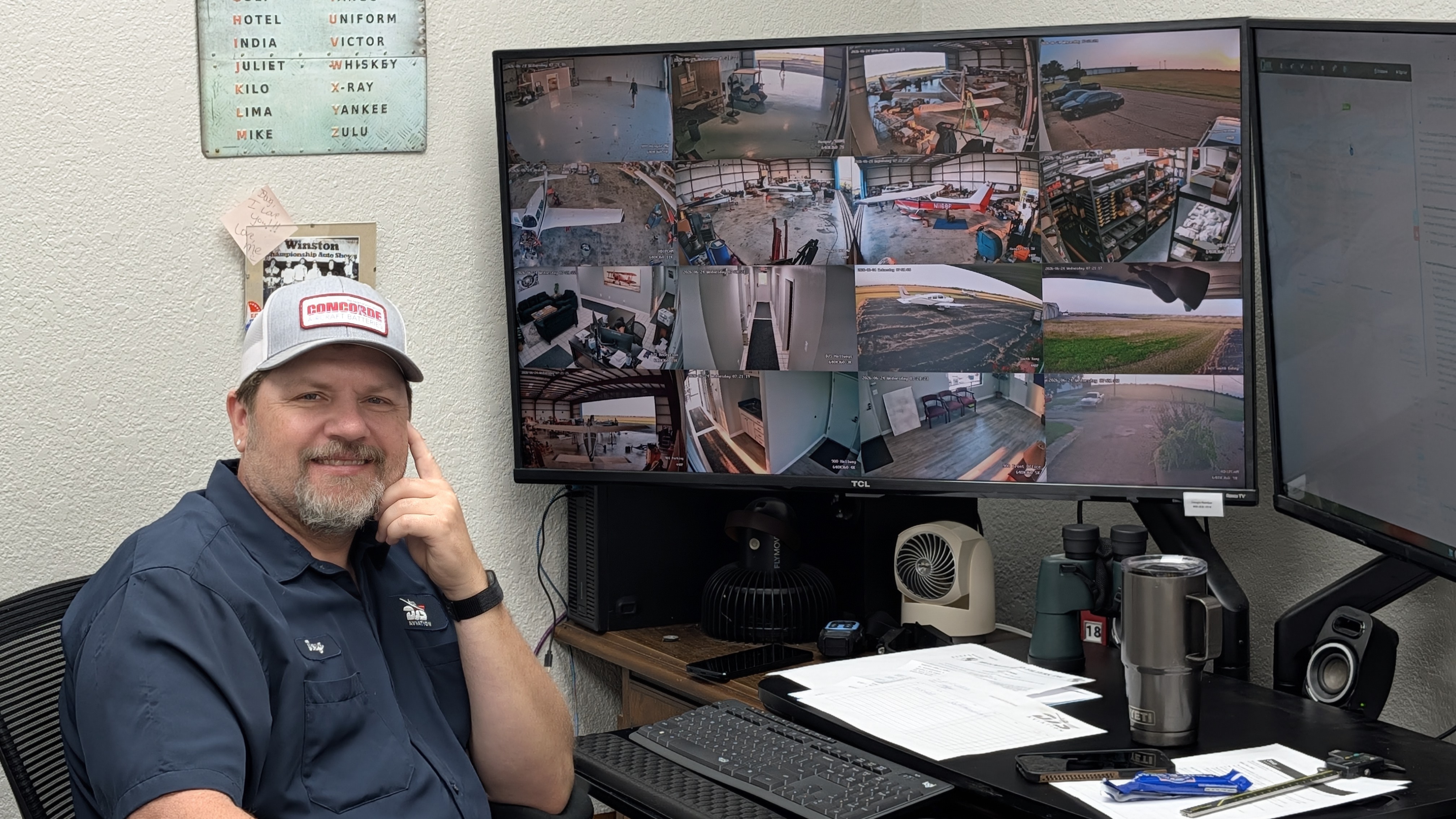
Doug at his desk at KCPT — every camera on the hangar, ramp, and facility visible behind him. That is what operations management looks like when it actually means something.
If you have had work done at DJS Aviation in the last ten years, there is a very good chance that the reason it was done correctly is Doug Kahanek. The photo above tells you something about how he works: that monitor shows every camera on the facility — the hangar floor, the ramp, the parts room, every corner of the operation — visible from his desk at once. That is not surveillance. That is the posture of someone who feels personally responsible for everything happening under the roof.
Doug has been with us for a decade as a certificated A&P mechanic and Inspection Authorization holder — the same IA that authorizes him to sign off annual inspections and certify major repairs and alterations as meeting FAA requirements. He is also a pilot, which matters more than the credential implies. A mechanic who flies understands, in a way that cannot be taught in a classroom, what it means for the work to be right. He has to fly behind it. — the same IA that authorizes him to sign off annual inspections and certify major repairs and alterations as meeting FAA requirements. He is also a pilot, which matters more than the credential implies. A mechanic who flies understands, in a way that cannot be taught in a classroom, what it means for the work to be right. He has to fly behind it.
Doug’s title is Operations Manager, but that language understates the role. He is, in the most practical sense, the standard. When an aircraft rolls out of our hangar, it is Doug’s judgment — and his signature — that certifies it is ready to return to service. His background is broad and genuinely rare: a mechanic of serious accomplishment in the automotive world before aviation claimed him, Doug brings to diagnosis an intuition that comes only from years of working with complex machinery across disciplines. He loves fast cars. He brings that same relentless precision to aircraft.
|
▶ Personnel Data Plate
|
|
Name
Doug Kahanek
|
Role
Operations Manager
|
|
Certificates
A&P Mechanic · Inspection Authorization · Pilot
|
With DJS
10 Years
|
|
Specialties
Engine rebuilding · Troubleshooting · FAA compliance & paperwork · Day-to-day operations management
|
What distinguishes Doug is not any single skill in isolation — it is the convergence of them. Patient, systematic troubleshooting in an era when genuine diagnostic ability is becoming rare. Engine rebuilding done in-house, with real depth, not outsourced and handed back. An understanding of FAA compliance and maintenance documentation that treats the logbook entry not as paperwork but as the official record on which every future owner, every future mechanic, and every future FAA inspector will rely. He understands that the standards do not bend because it is inconvenient. That every repair either meets requirements or it does not. That “close enough” is a phrase that does not exist in an airworthy aircraft.
Outside the hangar: fast cars and the kind of mechanical passion that led him here in the first place. Inside it: the calm, methodical focus that you want standing between your aircraft and the sky. Ten years in. Not one aircraft has left this facility wrong on his watch. That is not a claim. It is a record.
| |
Doug doesn’t talk about the standard. He holds it. Every annual he signs, every engine he rebuilds, every logbook entry he makes is the standard made visible. We are fortunate to have him — and so are the people who fly the aircraft that leave here.
|
|
|
✎
|
✦ Free Tool — Already Yours
The DJS AD Lookup is on your phone — if you want it
We mentioned this in the last issue and the response was worth mentioning again. The
DJS AD Lookup searches official Federal Register
records for any Airworthiness Directive by airframe, engine, propeller, or appliance —
or pulls any AD by number and gives it to you two ways: plain English and exactly as the
FAA wrote it, with direct links to source documents. No account. No cost. No advertising.
Install it once and it sits on your home screen like an app, ready the moment you need it at
a fly-in, a pre-buy, or an annual.
|
|
iPhone:
Open in Safari → tap Share → Add to Home Screen
|
|
Android:
Open in Chrome → tap Install when the banner appears
|
|
Open the AD Lookup ►
|
|
|
✈ Hangar Humor
“A student pilot asked his CFI, ‘What happens if both the engine and the radio quit at the same time?’ The CFI said, ‘You start flying and stop talking — just like the rest of us do on purpose.’”
|
|
✦ Subscriber-Only Offer
Restraint System Safety Check
|
Schedule any maintenance visit with DJS Aviation in July or August 2026 and we will include a complimentary seat belt and shoulder harness inspection at no charge — full TSO compliance verification, Y-junction and webbing inspection, inertia reel function check, and hardware condition assessment. We’ll also confirm your restraints are documented in the aircraft records.
|
✓
TSO compliance verified
|
|
✓
Y-junction & webbing inspected
|
|
|
✓
Inertia reel function checked
|
|
✓
Complimentary — zero charge
|
|
|
Book the Safety Check ►
Mention “Squawk Sheet #004” when you contact us. | Offer expires August 31, 2026.
|
|
★★★★★
Never Miss a Preflight
One or two emails a month. Real, verified, useful information for piston aircraft owners — never a sales pitch dressed up as an article. Never.
|
✓
AD alerts before they bite you
|
|
✓
Maintenance knowledge you can actually use
|
|
✓
Honest takes on the news shaping GA
|
|
✓
Written by people who fly and turn wrenches — period
|
Yes — Add Me to the List ►
Already subscribed?
Unsubscribe at any time.
|
Share with a hangar neighbor.
|
|
That is Issue #004. Look at your seat belts — seriously, today, before the next flight. Watch the CHTs on every July departure. Understand what your aircraft is worth and what keeps it worth that. And when you see Doug at the airport, tell him we said something nice. He’ll deny it, and then he’ll go fix something.
Fly early. Watch the gauges. Keep the blue side up.
— The crew at DJS Aviation LLC
|
|
|
|
DJS Aviation LLC
●●●●●●●●●●●●
1650 Airport Dr. #901 · Cleburne, TX 76033
Cleburne Municipal Airport (KCPT)
682-420-4677
●
operations@maildjs.com
●
djsaviationllc.com
The Squawk Sheet is published monthly by DJS Aviation LLC. Content is for informational purposes only.
AD compliance is the aircraft owner’s responsibility per 14 CFR Part 91.
Always verify against the official FAA AD database.
© 2026 DJS Aviation LLC. All rights reserved.
Unsubscribe
·
Subscribe
·
Share
|
|
|
|